
Two's Complement Floating Point Arithmetic System
Two's Complement Floating Point Arithmetic System
Spirix is a high-performance floating-point numeric system that utilizes two's complement for all components with adjustable range and precision. Spirix is designed to preserve mathematical identities and provide consistent behavior across the entire number line.
With Spirix, you can choose both fraction and exponent sizes independently, allowing for precision and range exactly where you need it. The system provides mathematically rigorous functionality and overcoming many limitations found in traditional floating-point representations.
Get usable results with escaped states even when values exceed range

Undefined states preserve first cause,
making debugging faster and easier
Values maintain orientation information even when magnitude is lost,
preserving mathematical continuity

First-class complex number type with all basic math operators

2x+ faster than comparable numeric types with similar precision
Use exactly the precision and range you want
A fundamental difference between Spirix and traditional floating-point systems is how numbers are represented at their core.
The IEEE-754 standard and other floating-point types use a sign-exponent-magnitude representation with a distinct positive magnitude and a sign bit. This creates a fundamental discontinuity at Zero, where every value has both a positive and negative representation that differs only by the sign bit.
Zero itself exists as both +0 and -0, despite attempting to represent the same mathematical value. This duplication creates confusing behavior, such as comparisons, for example in IEEE-754 -0=+0 returns 'TRUE' even tho they're distinct. The sign-magnitude approach introduces significant complexity in numerical operations, requiring separate paths for sign combinations, tedious rules for sign crossings, rounding, denormals and other combinations.

In contrast, Spirix achieves a continuous linear number space by utilizing two's complement where values wrap around naturally, maintaining linear relationships and eliminating the discontinuity at Zero.
With this approach, Zero becomes a point in the middle of the number line rather than a special case requiring separate handling. This continuity enables operations to cross the Zero boundary smoothly, allowing all basic operations (addition, subtraction, multiplication, division) without any sign-specific testing or branching. Rounding is appliend to all values uniformly, regardless of sign.
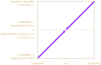
To understand the difference, consider these two interpretations of the same bit patterns:

The chart above shows the traditional unsigned interpretation of fraction bits, where values range from 0 at the bottom to MAX (all bits set to 1) at the top.
The chart below shows the same bit patterns but using a two's complement interpretation. Notice how the number line is essentially rotated vertically. The MSB (leftmost bit) now determines sign, with positive values (starting with 0 bit) in the upper half and negative values (starting with 1 bit) in the lower half. Zero and -1 are positioned naturally in the center of this continuous numeric space.
The Spirix Scalar comparisons arrange states and signs logically with positive exploded values being greatest, negative exploded values being least, and a continuous spectrum of states in between:
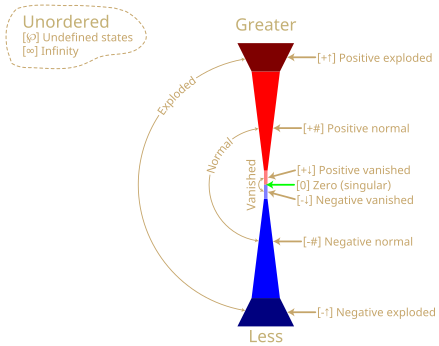
The Spirix number line arranges values logically with a continuous spectrum of states:
This continuous representation enables several benefits:
Spirix represents numbers using bit patterns that encode both the value's magnitude and state. The fundamental value calculation is straightforward: the numeric value equals the two's complement fraction multiplied by 2 raised to the exponent power (fraction × 2^exponent). The normalization level (N-1 for normal values, N-2 for vanished, etc.) determines the decimal point position within the binary fraction. For example, the number 42 encoded in a F3E3 Scalar would contain F=01010100, E=00000110. The value would be calculated as 0.1010100₂ × 2^00000110.₂ = 101010. (0.65625×2^6.=42.)
Each state in Spirix is identified by specific bit patterns in the fraction component:
Note that normal and exploded states share the same fraction pattern, entirely eliminating overflow handling in addition and subtraction and from the ambiguous exponent placement.
A key innovation in Spirix is the use of a single reserved exponent value to identify all non-normal states. An ambiguous state is indicated by the exponent having a one followed by all Zeros (E=1000000...). This unified approach allows for single detection of abnormal cases and provides improved mathematical consistency across operations.
When an exponent is ambiguous, the fraction pattern determines which non-normal state it's in:
Using an ambiguous exponent to identify all abnormal cases provides significant advantages:
Spirix is a complete numeric system that offers customizable precision and range while improving mathematical rigor. Its design addresses many limitations found in standard floating-point representations.
Spirix provides these benefits while maintaining high performance, with operations running more than twice as fast as IEEE-754 equivalents due to the simplified design.
Spirix preserves mathematical relationships that IEEE 754 often violates:
use spirix::{Scalar, ScalarF5E4};

// In IEEE 754, very small values can underflow to Zero
// In Spirix, they become vanished and maintain orientation
let not_zero = ScalarF5E4::MIN_POS * ScalarF5E4::MIN_POS;
let zero = f64::MIN_POS * f64::MIN_POS;
assert!(not_zero != 0);  // Spirix does not truncate to Zero
assert!(zero == 0);  // IEEE truncates to +0

// Division by Zero produces Infinity, not NaN or exception
let infinity = not_zero / 0;
assert!(infinity.is_infinite());

// Infinity behaves mathematically consistently
let still_infinity = infinity * 7;
assert!(still_infinity.is_infinite());

// And works with escaped values!
let also_infinity = infinity * not_zero;
assert!(also_infinity.is_infinite());More accurate representation of very small and very large numbers without losing sign or orientation information. Identity preservation enables more reliable numerical methods.
Predictable behavior with ambiguous values allows calculations to continue even when results exceed normal ranges, improving numerical stability in simulations and reducing edge cases.
Ability to choose independent fraction and exponent bit sizes which can reduce memory usage while maintaining mathematical rigor. Smaller hardware footprint leads to more efficient systems.
Preserving orientation information in exceptionally small and exceptionally large values helps maintain gradient stability in training algorithms.
Spirix achieves its advantages thru:
use spirix::{Scalar, Circle, ScalarF5E4, CircleF5E4};

fn main() {
    // Let's create a Scalar!
    let mut scalar = ScalarF5E4::from(42);
    println!("Original value: {}", scalar);
    // Internally creates and normalizes to N-1 level with a normal exponent

    // Continuous Mathematics
    // Create values that exceed normal representation
    let exploded = ScalarF5E4::MAX * 2;
    let vanished = ScalarF5E4::MIN_POS / -2;

    assert!(exploded.exploded());
    assert!(!exploded.is_infinite());
    assert!(vanished.vanished());
    assert!(!vanished.is_zero());

    // Operations work continuously even with escaped values
    let tiny = vanished / exploded;
    assert!(tiny != 0);
    assert!(tiny.is_negative());
    assert!(tiny.vanished());

    // Phase preservation
    let neg_tiny = -tiny;
    assert!(neg_tiny.is_positive());

    // Reciprocals maintain orientation
    let reciprocal = 1 / neg_tiny;
    assert!(reciprocal.exploded());
    assert!(reciprocal.is_positive());

    // Bitwise Operations on floating-point values
    let a = ScalarF5E4::from(42.5);
    let b = ScalarF5E4::from(6.25);

    // Aligns fractions before applying bitwise operations
    //  101010.10 (42.5)
    //  000110.01 (6.25)
    // &000010.00 (2)
    let bitwise_and = a & b;
    assert!(bitwise_and == 2);

    // Shifts work as power-of-two multipliers or divisors
    let shifted = a << 2;  // Multiply by 4
    assert!(shifted == 170);

    // Native complex arithmetic
    let z1 = CircleF5E4::from((1.5, 2));  // 1.5 + 2*i
    assert!(z1.magnitude() == 2.5);
    let z2 = CircleF5E4::from((1, -2)); // 1 - 2*i

    // Complex operations
    let product = z1 * z2;
    assert!(product == CircleF5E4::from((5.5, -1)));

    // Circles can be infinite too!
    let infinity = 8 / CircleF5E4::ZERO;
    assert!(infinity.is_infinite());
    assert!(infinity.is_transfinite()); // infinity is transfinite
    assert!(!infinity.exploded()); // But not exploded!
}Spirix uses normalization levels and an ambiguous exponent to track the state of each representation which enables Spirix to:
Zero in Spirix has a distinct representation with a unique bit pattern at the N-0 level. Unlike vanished values that approach but never equal Zero, this is the genuine, mathematical Zero that serves as the additive identity.
use spirix::{Scalar, ScalarF4E4};

// Zero is the additive identity
let zero = ScalarF4E4::ZERO;
let value = ScalarF4E4::from(42);
assert!(value + zero == value);

// Zero * anything = Zero
assert!(zero * value == zero);

// Except for Infinity times Zero, that's undefined
let infinity = value / 0;
let undefined = infinity * 0;
assert!(undefined.is_undefined());

// Zero over Zero creates a different undefined state
let different_undefined = 0 / zero;
assert!(different_undefined.is_undefined());Vanished values are numbers that have become so small their magnitude can no longer be stored but they are not Zero. Scalars retain their sign information and Circles maintain their orientation. Unlike actual Zero, vanished values have a non-Zero magnitude and Spirix records their phase/orientation as they approach Zero.
Properties of vanished values:
use spirix::{Scalar, ScalarF5E3};

// Creating vanished values
let vanished_positive = ScalarF5E3::MIN_POS / 42;
assert!(vanished_positive.vanished());
assert!(vanished_positive.is_positive());
assert!(vanished_positive != 0);

let vanished_negative = ScalarF5E3::MIN_POS * ScalarF5E3::MAX_NEG;
assert!(vanished_negative.vanished());
assert!(vanished_negative.is_negative());

// Addition treats vanished as Zero
let pizza = ScalarF5E3::from(3.14);
assert!(pizza + vanished_positive == pizza);

// Division by vanished produces exploded
let exploded = 2.5 / vanished_positive;
assert!(exploded.exploded());
assert!(exploded.is_positive());

// Multiplying two vanished values maintains vanished state
let product = vanished_positive * vanished_negative;
assert!(product.vanished());
assert!(product.is_negative()); // Sign follows multiplication rulesNormal values have a definite magnitude and participate fully in all arithmetic operations. These form the core representable range of Spirix, where arithmetic operations behave conventionally.
All normal values have:
use spirix::{Scalar, ScalarF5E3};

// Create normal values
let positive = ScalarF5E3::from(42);
let negative = ScalarF5E3::from(-3.14);

// Normal values participate in all operations as expected
let sum = positive + negative;
let product = positive * negative;
let quotient = positive / negative;Exploded values are numbers that have grown so large their magnitude can no longer be recorded but their magnitude is not infinite. Scalars maintain their sign and Circles maintain their orientation. They occur when magnitudes exceed the range determined by the exponent size.
Properties of exploded values:
use spirix::{Scalar, ScalarF4E3};

// Creating exploded values
let exploded = ScalarF4E3::MAX * 2;
assert!(exploded.exploded());
assert!(exploded.is_positive());
assert!(!exploded.is_infinite());

let exploded_negative = -exploded;
assert!(exploded_negative.exploded());
assert!(exploded_negative.is_negative());

// Multiplication works with exploded values
let still_exploded = exploded * 3;
assert!(still_exploded.exploded());

// Division works with exploded values too!
let neg_exploded = still_exploded / -25;
assert!(neg_exploded.is_negative());
assert!(neg_exploded.exploded());

// Addition with normal produces undefined
let undefined = exploded + 42;
assert!(undefined.is_undefined());Infinity in Spirix represents a singular state with a truly unbounded magnitude, not computational overflow. Unlike IEEE-754's signed infinities, Infinity is the result of genuine mathematical discontinuities like division by Zero. While exploded values indicate numbers too large to represent normally, Infinity represents a distinctly different concept.
Properties of Infinity:
use spirix::{Scalar, ScalarF5E7};

// Let's create an Infinity!
let infinity = 1 / ScalarF5E7::ZERO;
assert!(infinity.is_infinite());
assert!(!infinity.exploded()); // Infinity is not exploded
assert!(infinity.is_transfinite()); // But it is transfinite!

// Operations with Infinity
let still_infinity = infinity * 42;
assert!(still_infinity.is_infinite());

// Zero times Infinity is undefined, not Zero
let undefined = 0 * infinity;
assert!(undefined.is_undefined());

// Adding to Infinity produces undefined
let also_undefined = infinity + 1;
assert!(also_undefined.is_undefined());

// Even exploded values crumble to the weight of Infinity!
let massive = ScalarF5E7::MAX.pow(ScalarF5E7::MAX);
let zero = massive / infinity;
assert!(zero == 0);Undefined states in Spirix have:
Spirix returns unique undefined states that preserve information about what caused the undefined. This allows for faster debugging and tracing the root cause in calculations.
Unlike IEEE 754 where different NaN values are indistinguishable, Spirix provides a comprehensive catalog of undefined states that identify the specific mathematical operation that first produced the undefined:
| Undefined Type | Symbol | Description |
|---|---|---|
| General Undefined | [℘] | General undefined or unimplemented (IEEE-754 NaN maps to this) |
| Transfinite Plus Transfinite | [℘ ⬆+⬆] | Transfinite value addition with transfinite value |
| Transfinite Minus Transfinite | [℘ ⬆-⬆] | Transfinite value subtraction with transfinite value |
| Vanished Plus Vanished | [℘ ↓+↓] | Vanished value addition with vanished value |
| Vanished Minus Vanished | [℘ ↓-↓] | Vanished value subtraction with vanished value |
| Transfinite Plus Finite | [℘ ⬆+] | Transfinite value addition with finite value |
| Transfinite Minus Finite | [℘ ⬆-] | Transfinite value subtraction with finite value |
| Finite Plus Transfinite | [℘ +⬆] | Finite value addition with transfinite value |
| Finite Minus Transfinite | [℘ -⬆] | Finite value subtraction with transfinite value |
| Fractional Infinity | [℘ ⨅∞] | Fractional part of Infinity |
| Sign Indeterminate | [℘ ±∅] | Sign/direction of Zero or Infinity is indeterminate |
| Indeterminate | [℘⊥⊙] | Indeterminate Scalar → Circle conversion |
| Clamp Unordered | [℘ ∩] | Clamp with non-ordered ambiguous values |
| Max Unordered | [℘ ⌈] | Maximum of non-ordered ambiguous values |
| Min Unordered | [℘ ⌊] | Minimum of non-ordered ambiguous values |
| Transfinite Divide Transfinite | [℘ ⬆/⬆] | Transfinite value division by transfinite value |
| Negligible Divide Negligible | [℘ ⬇/⬇] | Negligible value division by negligible value |
| Transfinite Modulus | [℘ ⬆%] | Transfinite value modulus operation |
| Transfinite Modulo | [℘ ⬆‰] | Transfinite value modulo operation |
| Modulus Vanished | [℘ %↓] | Finite value modulus with vanished value |
| Modulo Vanished | [℘ ‰↓] | Finite value modulo with vanished value |
| Modulus Exploded | [℘ %↑] | Modulus with opposing sign exploded denominator |
| Modulo Exploded | [℘ ‰↑] | Modulo with opposing sign exploded denominator |
| Logical AND | [℘ &] | Logical AND with escaped value |
| Logical OR | [℘ |] | Logical OR with escaped value |
| Logical XOR | [℘ ⊻] | Logical XOR with escaped value |
| Logical NOT | [℘ !] | Logical NOT of escaped value |
| Negligible Multiply Transfinite | [℘ ⬇×⬆] | Negligible value multiplication with transfinite value |
| Transfinite Multiply Negligible | [℘ ⬆×⬇] | Transfinite value multiplication with negligible value |
| Transfinite Power | [℘ ⬆^] | Transfinite value raised to power |
| Negligible Power | [℘ ⬇^] | Vanished value raised to power |
| Power Transfinite | [℘ ^⬆] | Value raised to transfinite power |
| Power Negligible | [℘ ^⬇] | Value raised to vanished power |
| Negative Power | [℘ -^] | Negative value raised to irrational power |
| Log One | [℘ @1] | Logarithm base One |
| Square Root Negative | [℘ √-] | Square root of negative value |
| Square Root Exploded | [℘ √↑] | Square root of transfinite value |
| Square Root Vanished | [℘ √↓] | Square root of vanished value |
| Transfinite Log | [℘ ⬆@] | Logarithm of transfinite value |
| Negligible Log | [℘ ⬇@] | Logarithm of negligible value |
| Log Transfinite | [℘ @⬆] | Logarithm with transfinite base |
| Log Negligible | [℘ @⬇] | Logarithm with negligible base |
| Negative Log | [℘ -@] | Logarithm of negative value |
| Log Negative | [℘ @-] | Logarithm with negative base |
| Sine | [℘ s] | Sine of value with imprecise period position |
| Cosine | [℘ c] | Cosine of value with imprecise period position |
| Arcsine | [℘ S] | Arcsine of value outside domain [-1,1] |
| Arccosine | [℘ C] | Arccosine of value outside domain [-1,1] |
| Tangent | [℘ t] | Tangent of value with imprecise period position |
The difference in computational efficiency between IEEE-754 and Spirix is clear when examining how subtraction works in both systems:
Check if either operand is NaN, ±∞, or ±0
Apply special case rules (e.g., NaN dominates, infinities of same sign yield NaN)
Early exit for special value combinations
Extract sign bits, exponents, and significands
Unbias the exponent (Subtract from RAW exponent value)
Identify denormalized inputs based on exponent value
Based on sign bits, determine if subtraction becomes addition
Effective operation: A - B = A + (-B)
Use either add or subtract branch depending on input signs
Check for denormalized operands
For denormals: No implicit leading 1, exponent = 0
For normals: Add implicit leading 1 bit to significand
Compare exponents to determine larger value
Swap operands if needed to ensure larger operand is first
Calculate exponent difference
Use larger operand's exponent as result exponent (pre-normalization)
Right-shift smaller operand's significand by exponent difference
Save shifted-out bits for rounding later
Perform actual operation with significands
Check if operation crossed Zero (-4 + 5)
Handle borrow if needed
Adjust sign if needed
Check if result significand is Zero
Apply IEEE Zero sign rules if needed
Count leading Zeros in result significand
Determine if shift would denormalize significand
Left-shift result significand to eliminate leading Zeros
Decrement exponent for each bit shifted
Handle various underflow/overflow combinations
Check if resulting exponent would be less than minimum
If so, prepare for denormalized result handling
If result would have exponent < emin, shift significand right
Adjust to produce denormalized with exponent = emin
Collect all bits shifted out during alignment and normalization
OR them together to form sticky bit for rounding
Identify guard bit (first bit shifted out during alignment)
Identify round bit (second bit shifted out)
Apply selected rounding mode (default: round-to-nearest-even)
Determine if rounding up or down based on guard, round, sticky bits
Add 1 to LSB if rounding up
Leave as is if rounding down
Handle cases where rounding causes carry that affects normalization
Check if rounding caused carry that requires renormalization
If significand overflows, right-shift and increment exponent
Check if final exponent exceeds allowed range
Overflow: exponent > emax
Underflow: exponent < emin with non-Zero significand
Overflow: Set to appropriate infinity or largest representable value
Underflow: Set to Zero or smallest representable value
Set appropriate status flags (inexact, underflow, overflow, invalid)
These are preserved for later error handling
Combine sign bit, unbias exponent
Remove implicit leading bit if needed
Final format compliance check
Single check handles all abnormal cases
Determine which value has larger exponent
Skip shifts if difference exceeds fraction bits
Shift smaller fraction by exponent difference
Subtract fractions! No sign handling needed.
Normalize result (shift fraction left)
Adjust exponent by shift amount
Check exponent for underflow
If underflow, set exponent ambiguous, shift fraction right 1
No overflow checks necessary since the ambiguous exponent is one greater than MAX_EXPONENT and normal shares N-1 with exploded
Spirix operations run quite a bit faster than IEEE-754 equivalents with more predictable behavior, especially for complex arithmetic.
The simplicity of the Spirix design makes hardware implementation smaller and faster.
Spirix provides two primary numeric types:
pub struct Scalar<F: Integer, E: Integer> {
	/// The normalized fraction component representing the significand.
	/// The fraction size determines the precision of the value.
	/// The N (prefix bit) pattern determines the Scalar's state
	/// (normal, exploded, vanished, Zero or undefined/unimplemented).
	pub fraction: F,

	/// The exponent component determining the scale of the value/phase.
	/// The exponent size determines the range of the value/phase.
	/// When equal to AMBIGUOUS_EXPONENT (1000000...), indicates an abnormal state
	/// (exploded, vanished, undefined/unimplemented Infinity or Zero).
	pub exponent: E,
}pub struct Circle<F: Integer, E: Integer> {
/// The real phase representing the real part of the complex number.
pub real: F,
/// The imaginary phase representing the imaginary part of the complex number.
pub imaginary: F,
/// The shared exponent determining the scale of both phases.
/// When equal to AMBIGUOUS_EXPONENT (1000000...), indicates an abnormal state.
pub exponent: E,
}Both types can utilize any of Rust's native signed integer types (i8, i16, i32, i64, i128) for their components, allowing you to select any precision you want.
let supa_light: ScalarF3E3 = Scalar::<i8, i8>::from(42);
let to_ieee_infinity_and_beyond = Scalar::<i8, i128>::MAX;
let very_precise: ScalarF7E3 = 1.202056903159594285399738161511449990764986292;For convenience, Spirix provides type aliases for all valid Rust fraction and exponent combinations. Here are some examples:
// Format: F#E# (Fraction bits, Exponent bits)
pub type ScalarF5E3 = Scalar<i32, i8> // 32-bit fraction, 8-bit exponent
pub type ScalarF4E4 = Scalar<i16, i16> // 16-bit fraction, 16-bit exponent
pub type ScalarF6E4 = Scalar<i64, i16> // 64-bit fraction, 16-bit exponent
pub type ScalarF6E6 = Scalar<i64, i64> // 64-bit fraction, 64-bit exponent
pub type CircleF7E7 = Circle<i128, i8> // Really good for the Mandelbrot set!
Similarly for complex numbers with CircleF5E3, CircleF4E4, etc.
Select your ideal balance between decimal digits of Precision and Range
F3
2.1 digits
(i8)
F4
4.5 digits
(i16)
F5
9.3 digits
(i32)
F6
18.9 digits
(i64)
F7
38.2 digits
(i128)
E3 Range
10^38.5
(i8)
E4 Range
10^9860
(i16)
E5 Range
10^(10^8.81)
(i32)
E6 Range
10^(10^18.4)
(i64)
E7 Range
10^(10^37.7)
(i128)
| + | [0] | [↓] | [#] | [↑] | [∞] | [℘?] |
|---|---|---|---|---|---|---|
| [0] | [0] | [↓] | [#] | [℘+⬆] | [℘+⬆] | [℘?] |
| [↓] | [↓] | [℘↓+↓] | [#] | [℘ +⬆] | [℘ +⬆] | [℘?] |
| [#] | [#] | [#] | [0], [#], [↓], [↑] |
[℘ +⬆] | [℘ +⬆] | [℘?] |
| [↑] | [℘ ⬆+] | [℘ ⬆+] | [℘ ⬆+] | [℘ ⬆+⬆] | [℘ ⬆+⬆] | [℘?] |
| [∞] | [℘ +⬆] | [℘ +⬆] | [℘ +⬆] | [℘ ⬆+⬆] | [℘ ⬆+⬆] | [℘?] |
| [℘?] | [℘?] | [℘?] | [℘?] | [℘?] | [℘?] | [℘?] |
| - | [0] | [↓] | [#] | [↑] | [∞] | [℘?] |
|---|---|---|---|---|---|---|
| [0] | [0] | [↓] | [#] | [℘-⬆] | [℘-⬆] | [℘?] |
| [↓] | [↓] | [℘↓-↓] | [#] | [℘ -⬆] | [℘ -⬆] | [℘?] |
| [#] | [#], [↓], [↑] |
[#], [↓], [↑] |
[0], [#], [↓], [↑] |
[℘ -⬆] | [℘ -⬆] | [℘?] |
| [↑] | [℘ ⬆-] | [℘ ⬆-] | [℘ ⬆-] | [℘ ⬆-⬆] | [℘ ⬆-⬆] | [℘?] |
| [∞] | [℘ -⬆] | [℘ -⬆] | [℘ -⬆] | [℘ ⬆-⬆] | [℘ ⬆-⬆] | [℘?] |
| [℘?] | [℘?] | [℘?] | [℘?] | [℘?] | [℘?] | [℘?] |
| × | [0] | [↓] | [#] | [↑] | [∞] | [℘?] |
|---|---|---|---|---|---|---|
| [0] | [0] | [0] | [0] | [0] | [℘⬆×⬇] | [℘?] |
| [↓] | [0] | [↓] | [↓] | [℘⬆×⬇] | [∞] | [℘?] |
| [#] | [0] | [↓] | [#], [↓], [↑] |
[↑] | [∞] | [℘?] |
| [↑] | [0] | [℘ ⬇-⬆] | [↑] | [↑] | [∞] | [℘?] |
| [∞] | [℘ ⬇-⬆] | [∞] | [∞] | [∞] | [∞] | [℘?] |
| [℘?] | [℘?] | [℘?] | [℘?] | [℘?] | [℘?] | [℘?] |
| ÷ | [0] | [↓] | [#] | [↑] | [∞] | [℘?] |
|---|---|---|---|---|---|---|
| [0] | [℘ ⬇/⬇] | [∞] | [∞] | [∞] | [∞] | [℘?] |
| [↓] | [0] | [℘ ⬇/⬇] | [↑] | [↑] | [∞] | [℘?] |
| [#] | [0] | [↓] | [#], [↓], [↑] |
[↑] | [∞] | [℘?] |
| [↑] | [0] | [↓] | [↓] | [℘ ⬆/⬆] | [∞] | [℘?] |
| [∞] | [0] | [0] | [0] | [0] | [℘ ⬆/⬆] | [℘?] |
| [℘?] | [℘?] | [℘?] | [℘?] | [℘?] | [℘?] | [℘?] |
Spirix represents a fundamental redesign of floating-point arithmetic built on two's complement representation thruout the entire calculation pipeline. The key technical advantages include:
Spirix was designed with practical implementation in mind. Its simplified operational pipeline makes it well-suited for both software libraries and hardware acceleration. The system is parameterized to allow flexible deployment across various hardware targets with different precision and range requirements.
The continuous number line and elimination of many special cases significantly reduce both the complexity and power requirements of arithmetic logic, creating opportunities for more efficient compute engines, particularly for complex number operations common in scientific computing, physical simulations, and spectral processing.
Dramatic reduction in instruction count and branching complexity translates to higher thruput and lower power consumption for all floating-point operations, with even greater gains for complex arithmetic.
Customizable fraction and exponent sizing enables optimized balance between range and precision for specific workloads, while maintaining mathematical consistency across operations.
Mathematically coherent behavior at extreme values and singularities creates more reliable and predictable numerical algorithms, reducing the need for special case handling in software.
Spirix offers a technically sound alternative to IEEE-754 that addresses fundamental limitations in current floating-point implementations. Its two's complement approach simplifies the computational pipeline while simultaneously improving mathematical consistency. The performance improvements and reduced complexity demonstrated in the reference implementation indicate substantial potential benefits for next-generation computing architectures.
Spirix is licensed under a custom license that permits:
Prohibited:
For full license details, see the LICENSE file.
For questions, commercial licensing, or other language implementation approval: